What Unlocks the Confidence to Price Your Own Knowledge?
Picture a legal pad on a kitchen table, one line printed near the top: Price: $____. The pen has been resting there for ten minutes. Everything else about the plan is finished. The pages are written, the idea is solid, and still that one blank line will not fill itself in.
This is where a lot of people get stuck the first time they think seriously about pricing your knowledge. Not the writing. Not the idea. The number.
I hear some version of this often: “I know how to solve certain problems, but I don’t know how to turn that into an online business.” Pricing is usually the exact spot where that thought runs into a wall, because a number on a page feels like it has to be defended, and nobody wants to defend a guess.
Here is the part that helps: the number does not need to come from a guess at all. It can come from a handful of plain questions, answered honestly, one at a time.
The Guess That Costs More Than It Looks
Most people set a price the same way. They look at what someone else charges for something similar, land somewhere close to it, and hope.
That guess is expensive in ways that do not show up right away. Price too low, and the people who show up are the ones who question everything, including you. Price too high with nothing behind the number, and doubt creeps into every email you send about it. Say two people teach the exact same skill. One charges forty dollars because a competitor charges forty dollars. The other charges two hundred because they can point to the specific result, the specific audience, and the specific proof behind it. The second number holds up under a single follow-up question. The first one does not.
I’ve noticed this hesitation come up again in other articles I have shared recently, and it usually traces back to the same root problem. The person has not yet answered, for themselves, why the number is what it is.
Where the Confidence Comes From
Nick James, whose training I still work through today, talks about this exact moment. He tells a story about standing in a room before a one-day workshop and watching the organizer collect close to one hundred thousand dollars from fifty people before a single word had been spoken.
The point he draws from it is not about the size of the number. It is that the price only felt believable to that room because there were real reasons sitting underneath it: a clear result, a clear audience, and evidence the thing already worked for someone else.
He talks about running a price through a short set of honest checks rather than a single guess. What is the actual transformation. What would this be worth to the person living without it. What do similar offers already charge, and where does this one sit against them.
None of that produces a perfect number on the first try. What it produces is a number you can explain out loud without your voice changing.
What My Own First Sale Taught Me About This
I have not priced a product of my own yet. That is still ahead of me, not behind me. But I learned something adjacent to it the day my first sale came in through my current coach’s program.
I felt proud rather than uneasy, and the reason was simple. I fully understood how and why that sale had happened, and I believed in what the buyer had bought. There was no second thought sitting behind it.
That is the same feeling a fair price is supposed to give you. Not relief that somebody paid. Understanding of exactly why they should.
It was a night and day difference from earlier programs I had been part of, where I could not have explained the value with a straight face, let alone a number. Once I understood what I was recommending, the doubt went away on its own.
Understanding of exactly why they should is the feeling a fair price is supposed to give you.
The same shift applies before a single sale has happened. If you cannot say plainly why your price is what it is, the number probably was not built yet. It was borrowed.
Three Questions Before You Write the Number Down
You do not need a formula memorized to do this. That is really all pricing your knowledge comes down to: three honest answers written next to each other.
What does this change for the person on the other end, and how quickly does it change it. A result reached in a week is worth more than the same result stretched across six months, and most people already know this without being told. A course that gets someone hired in two weeks is worth more than one that takes six months to show any result. That holds even if the lesson content looks almost the same on paper.
What do similar offers already charge, and does yours belong in a crowded lane or a narrow one. A narrow, specific lane gives you far more room to set your own number than a lane everyone else is already standing in. A course titled How To Start An Online Business competes with a thousand others. A course titled How To Turn Thirty Years Of Bookkeeping Experience Into A Consulting Practice competes with almost none.
What would this need to earn, this year, for the effort to be worth it. Working that number backward changes how the whole thing looks. A handful of sales at a price you can defend covers more ground than a flood of sales at a price you cannot. If the goal is five thousand dollars this year, that might mean fifty sales at a hundred dollars, or ten sales at five hundred. Working backward from the number you need changes which price makes sense long before you write anything down.
Write short answers under each question. You are not looking for certainty. You are looking for reasons you did not have five minutes ago.
The Part Nobody Tells You
Some of your answers will pull the number up. Some will pull it down. Maybe the transformation is fast but the audience is crowded, or the audience is narrow but the result takes months to show. That tension is not a problem to solve before you publish anything. It is information about your own offer that is worth having early rather than late.
Specific always beats vague, in a price the same way it beats vague everywhere else. A number with three honest reasons behind it will outsell a bigger number with none, almost every time.
You are not trying to land on a figure that impresses anyone. You are trying to land on one you would still be comfortable explaining to a stranger over coffee, six months from now, with no script in front of you.
That is the whole test. Not whether the number sounds bold. Whether you could still say it out loud, without flinching, a long time after you first wrote it down.
That is what pricing your knowledge looks like in practice: filling in that blank line the same slow way I learned to trust my own first sale. Understand it first. The number gets a lot easier to write once you do.
Think and do, then do it better next time.
John Zurales
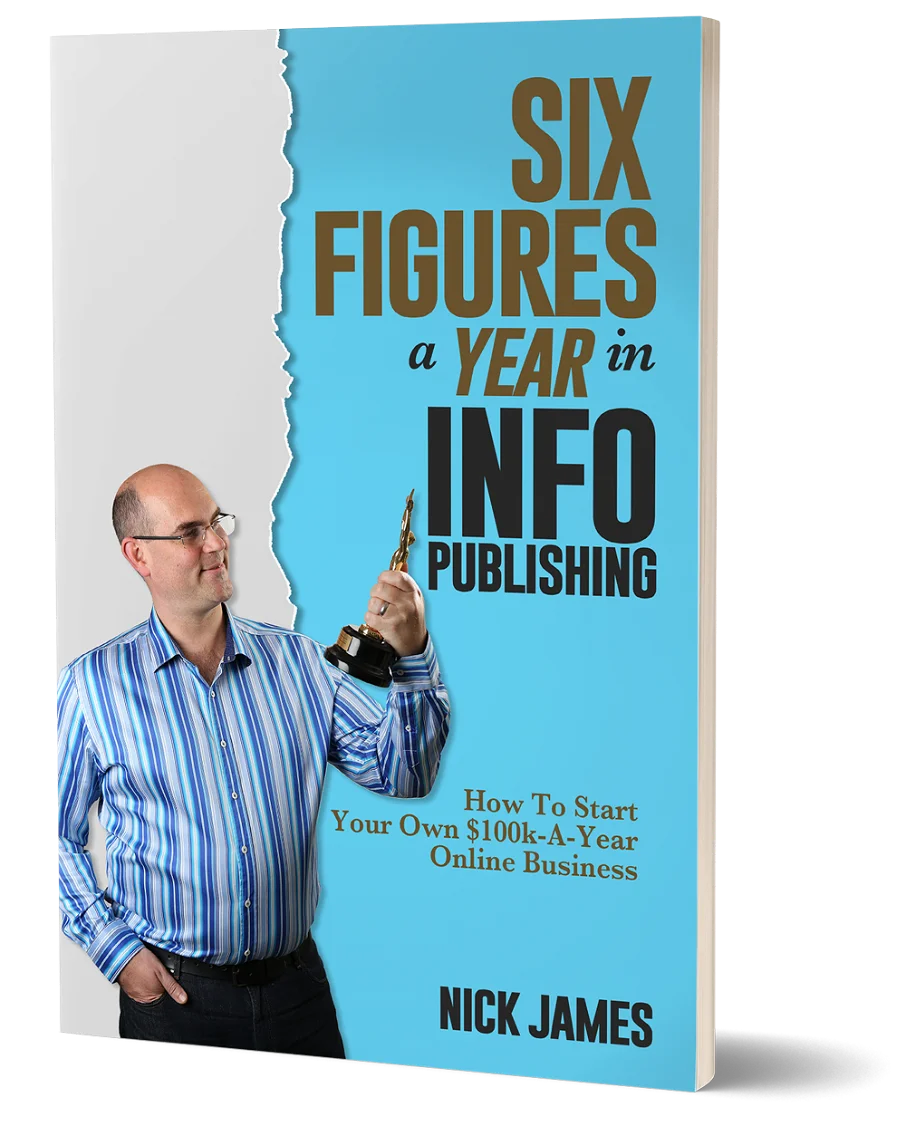
Author offers a FREE copy of this book to his next door neighbor... to prove he's not a drug dealer!
Now claim your FREE COPY.
and follow the step-by-step instructions for making the kind of money (and living the kind of lifestyle) that'll get your neighbors curtains twitching with curiosity!
Enter your details below to discover how to claim your FREE COPY of 'Six Figures A Year In Info Publishing' ...
Privacy Policy : We value your privacy. You can unsubscribe from receiving future emails with 1 click at any time.