How to Review Your Wins and Reveal Your Smartest Next Step
“I don’t want my wife thinking I’m spending all this time and money for nothing.” That worry lives quietly under a lot of what happens at a kitchen table or in a spare bedroom office, long after a first career has wound down.
Here is the part that makes it worse. Most people only review what went wrong. A slow month gets picked apart line by line. A good month gets a quiet nod, and then everyone moves on.
That is backwards. If you want fewer slow months, you need to know exactly why the good ones happened, not just that they did. Learning to review your wins, on a schedule, is one of the simplest habits a solo business owner can build.
This matters even more when you are building something later in your working life, on hours you do not have to spare for guessing. You need to know what worked, quickly, so you can do more of it on purpose instead of hoping it happens again.
Looking Back Only When Something Goes Wrong
Think about your best week in business over the last year. Can you say, specifically, why it went so well?
Most people cannot. They remember the feeling. The actual cause gets lost somewhere between the celebration and the next task on the list.
The same habit shows up with a bad week, just pointed the other way. A flop gets blamed on bad timing or bad luck, and then it quietly repeats itself a few months later, wearing a slightly different coat.
Neither reaction teaches you anything. One hides what is working. The other hides what is broken. Both leave you running the same business by accident instead of by design.
A Win You Never Examine Is Luck You Cannot Repeat
I picked up this idea from Nick James, whose teaching I have followed for a while now. It has stuck with me more than most things I have read on the subject, and it is worth sticking with you too.
A win you never examine is luck you cannot repeat.
That line applies just as well to a corporate career as it does to a side business. I spent years translating complicated detail for colleagues who only wanted the bottom line, and the lesson was always the same: you cannot manage what you have not actually looked at.
Review your wins the same way you would a mistake, and a strange thing happens. The good month stops feeling like luck. It starts feeling like a recipe.
Four Honest Questions, Once a Week
You do not need software or a complicated dashboard for this. A notebook and twenty minutes will do it.
Ask these four things about the last week or month:
What went right. What went wrong. What is worth repeating. What is worth cutting.
Write the answers down in plain language, in your own words. You are not writing a report for anyone else, so there is no reason to dress it up.
This is also a good place to glance back at other articles I have shared recently, since a few of them touch on building simple habits like this one without turning your business into a part-time job of its own.
Most people skip this step entirely, because a win feels like proof enough on its own. It is not proof. It is a clue, and your job is to really read it.
What the Lathe Taught Me About Reviewing Feedback
I picked up laser engraving and woodturning as a hobby a few years ago, mostly as a break from staring at a screen. I put a 2 inch by 2 inch block of wood on the lathe, about 8 inches long, and turned it on at roughly 800 rpm. I had the instructions fresh in my head.
I made a good first cut. Then I moved the tool left without backing it out first, the way I had been told not to. The wood flew off the lathe and landed about four feet away.
The instructor came over and guided my hands through the next cut, and that is when the earlier explanation finally made sense. It flew off a couple more times before I got the feel of it. I finished turning that block into my first ice cream scoop that same day, with a mahogany handle.
You will have your own version of that flying scoop moment somewhere in your business, the instant a mistake teaches you more than any instruction ever did. Pay attention when it happens to you.
No amount of listening got me there on its own. It took doing the thing, watching exactly where it went wrong, and adjusting on the next pass. That is review your wins and your misses in its most physical form, and it works the same way at a desk as it does at a lathe.
Decide What to Repeat, Fix, or Cut
Once you have your list, sort each item into one of three piles.
Repeat it. If an email, a post or a small change produced a result, do it again before you assume it was a fluke. One good week is a hint. Three good weeks in a row, using the same approach, is a pattern.
Fix it. Some problems have an obvious answer once you name them. A slow page, a confusing offer, a late start. Note the fix and move on.
Cut it. Some things cost you time or money and give almost nothing back, and no amount of tweaking is going to change that. Dropping those is not giving up. It is freeing up hours for the parts of the business that are actually working.
This is the piece most reviews skip, and it is the one that actually changes anything. A list of observations with no decision attached just sits in a notebook.
Keep the System Small Enough to Actually Run
This does not need to turn into another job. Pick a day, Friday afternoon or Sunday evening, and give it twenty minutes.
Ask the four questions. Sort the answers into the three piles. Write down one single change you will make next week because of what you found.
That is the whole system. No special tools, no elaborate spreadsheet, nothing to buy.
Do this for a month and you will have something most people building a business later in life never get around to building. A record of what really works for you, written in your own words, that you can look back on when the doubt creeps in.
Review your wins the same way you review your misses, on a schedule, and the good months stop being something that happens to you. They start being something you build.
Press the button. You’ll learn more from doing than researching.
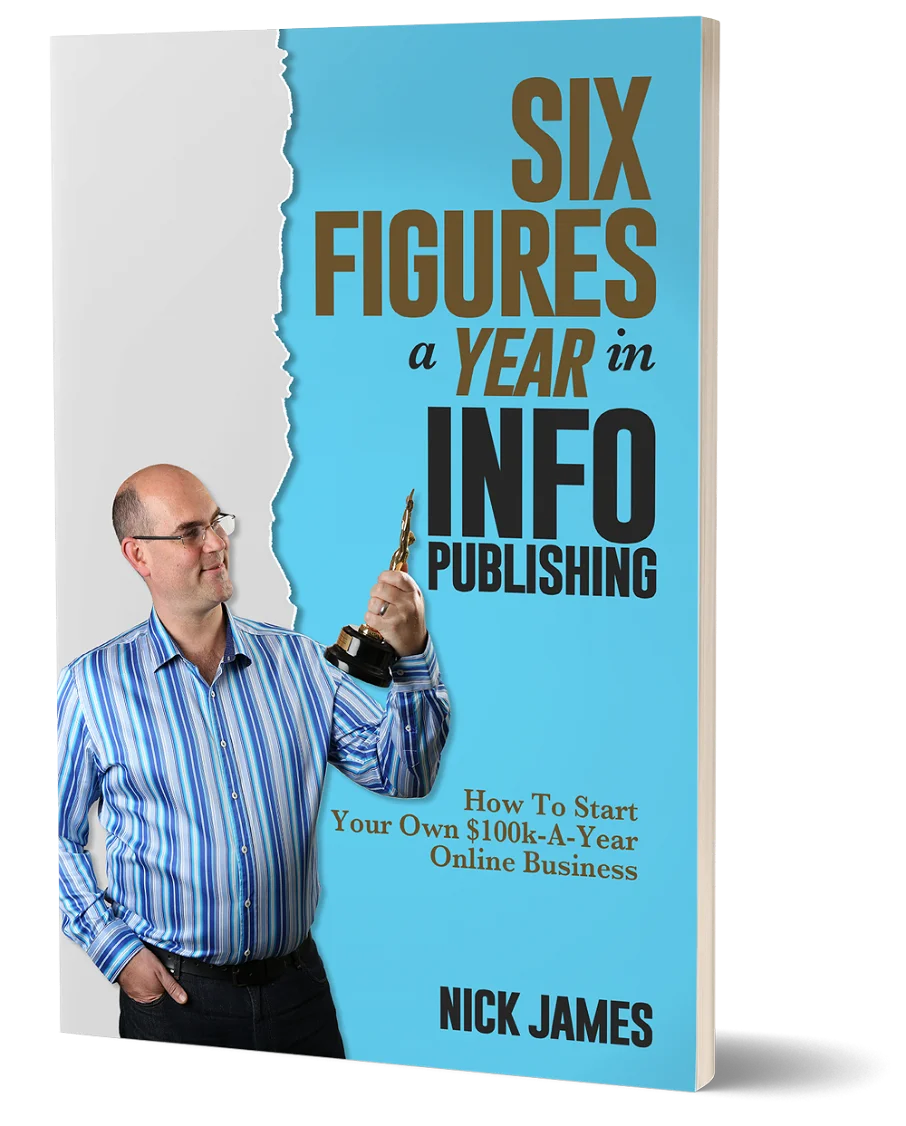
Author offers a FREE copy of this book to his next door neighbor... to prove he's not a drug dealer!
Now claim your FREE COPY.
and follow the step-by-step instructions for making the kind of money (and living the kind of lifestyle) that'll get your neighbors curtains twitching with curiosity!
Enter your details below to discover how to claim your FREE COPY of 'Six Figures A Year In Info Publishing' ...
Privacy Policy : We value your privacy. You can unsubscribe from receiving future emails with 1 click at any time.


