What Does the Business Clarity Test Reveal About Whether Strangers Trust You?
“I know how to solve certain problems, but I don’t know how to turn that into an online business.” I hear some version of that line more than almost anything else from people who first find their way to my site.
They spent thirty years fixing real problems for real people. Somehow none of that seems to translate into something a stranger online would recognize, let alone pay for.
The gap is not really a mystery. It is a clarity problem. A stranger scrolling past your website has about ten seconds to decide whether you are for them.
Most of us never spell that out, not for our reader and not even for ourselves. That is what today’s business clarity test is built to fix.
It takes about twenty minutes, needs no software, and gives you four short lines that tell anyone, human or otherwise, exactly what you do, who you help, and why they should stick around long enough to find out more.
Why Strangers Guess Before They Trust You
Here is something worth sitting with. If your homepage does not say clearly who you help and what you provide, your visitor does not wait patiently for you to explain it later.
Their brain fills the gap with a guess, and the guess is almost always more skeptical than the truth. This is exactly what the business clarity test measures.
Picture two homepages side by side. One says “helping you achieve your dreams” and stops there. The other says “I help retired teachers turn thirty years of lesson planning into a paid online course” and stops there too. The second one wins before the visitor reads another word, because a stranger can picture exactly who it is for.
That is doubly true for the kind of visitor I write for. They have already been burned once by a bold promise that turned out to be vague on purpose.
They are not looking for excitement. They are looking for a business that sounds like it knows exactly what it is.
I have circled around this idea from a few angles in other articles I have shared recently. It keeps showing up as the real obstacle underneath a dozen different symptoms: low sign-ups, confused emails, a homepage nobody quite understands.
Build Your Four Line Fact Box
Forget rewriting your whole website today. This is the core of the business clarity test. Start with four plain sentences, written the way you would say them to a neighbor, not the way a brochure would say them.
We are: what kind of business this actually is, in a few words.
We help: the specific person you are built for, not everyone.
We provide: the actual thing they get from you.
Our confidence comes from: the real experience or proof behind it.
The trick is precision, not polish. “We help people succeed online” tells a stranger nothing. “We help people over fifty package what they already know into something they can sell” tells them everything in one breath.
Say It Out Loud Before You Publish It
Read your four lines to someone who has never heard of your business. If they can repeat back what you do in their own words, the fact box is doing its job. If they squint and ask a follow-up question, you have found exactly what to fix.
What My Study Group Discovered About Being Clear
Years ago, while I was still working through a handful of small accountability groups, most of us shared the same quiet worry. We had all seen programs built entirely on a big show, and we wanted no part of building our own businesses the same way.
What surprised me was how often that worry showed up in the actual words people wrote. We would trade homepage drafts and email openers, and the ones that sounded confident on the surface were usually the vaguest underneath. The ones that admitted something specific and small, a real audience, a real limitation, a real starting point, felt honest to read.
It turned out that building something we could be proud of was harder to find than any of us expected. Clarity was almost always the missing ingredient rather than enthusiasm.
The same test applies to your fact box. If a line could sit unchanged on a competitor’s site, it is doing decoration, not description. Write the version only your business could truthfully claim.
Clarity is not about sounding impressive. It is about being impossible to mistake for someone else.
Testing It On Your Own Words
Once your four lines exist, go looking for the places they should already be showing up. Your homepage headline, your about page, your welcome email, your author bio. Each one should tell roughly the same story, not five different versions of your business depending on where a reader lands.
If your homepage says you help “everyone build an online business” but your welcome email suddenly narrows to “women over fifty starting a consulting practice,” a careful reader notices the mismatch even if they cannot name what feels off.
This is not about repeating the same sentence everywhere. It is about making sure nobody could read two of your pages and wonder if they belong to two different people.
A reader who feels uncertain does not ask for clarification. They quietly leave and try somebody else instead.
Check What You Are Actually Proud Of
Your fourth line, the proof line, deserves the most honesty of anyone here. You do not need a big number or a dramatic result.
“I have been doing this for about ten years” is proof. “I built this after years of trial and error” is proof. Small and true beats big and vague every single time.
Compare a weak proof line with a strong one. “I have helped a lot of people over the years” could belong to anyone. “I spent about ten years building this in the corporate office before doing it my own way” belongs to exactly one person, and that specificity is what makes a stranger believe it.
One Page Is Enough To Start
You do not need a rebrand this week. That is the business clarity test in practice.
You need one page, maybe your homepage or your about page. Rewrite it around four honest lines instead of a paragraph written to sound like everyone else’s.
Pick that one page today. Write your four lines first, then rebuild the page around them rather than the other way around.
A reader who understands exactly what you do in the first ten seconds is a reader who sticks around long enough to decide they trust you. That decision is the whole reason any of this is worth doing.
Think and do, then do it better next time.
John
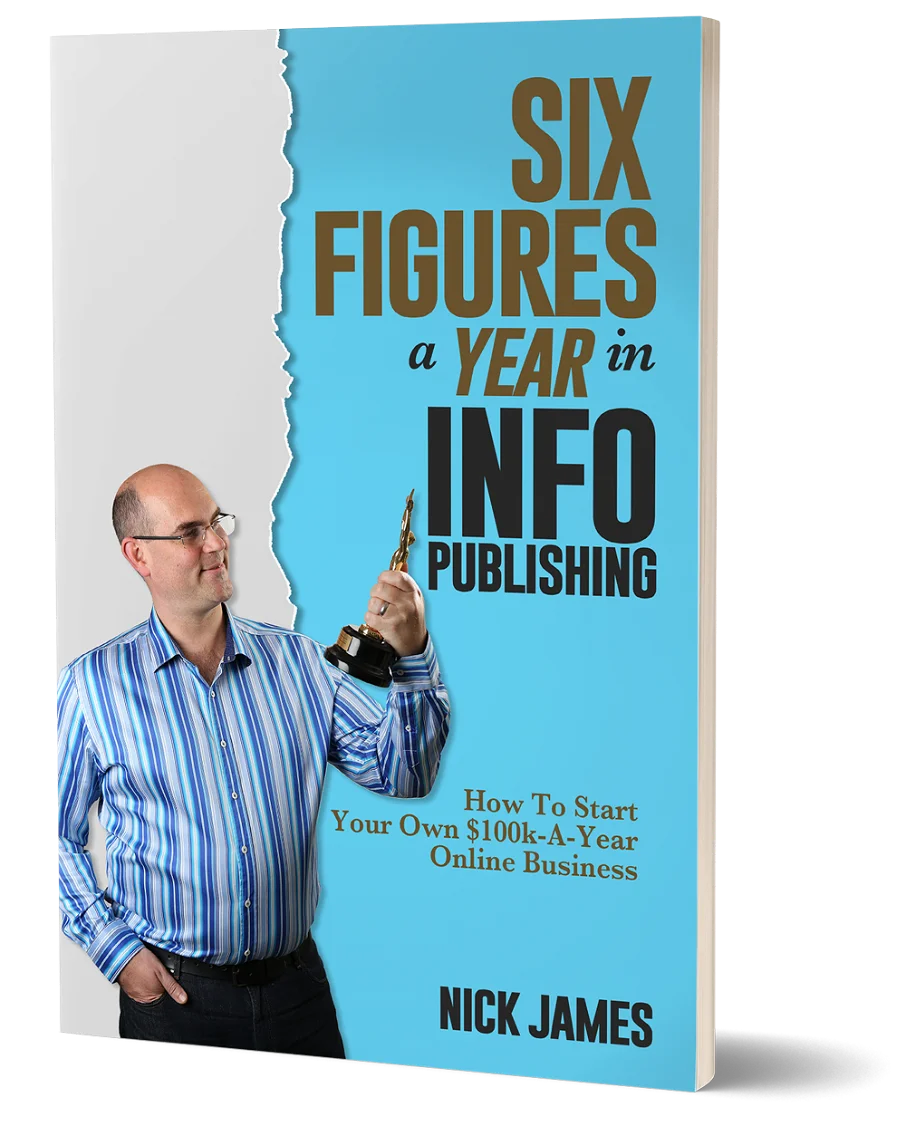
Author offers a FREE copy of this book to his next door neighbor... to prove he's not a drug dealer!
Now claim your FREE COPY.
and follow the step-by-step instructions for making the kind of money (and living the kind of lifestyle) that'll get your neighbors curtains twitching with curiosity!
Enter your details below to discover how to claim your FREE COPY of 'Six Figures A Year In Info Publishing' ...
Privacy Policy : We value your privacy. You can unsubscribe from receiving future emails with 1 click at any time.